The purpose of this blog is to provide a reference point for Performance Improvement and Certified Performance Technology (CPT) professionals to understand the arena of international development. The goal is to encourage the focus and energies of performance improvement (PI) practitioners to apply HPT/HICD technology in transitioning society development.
Giving money directly to poor people works surprisingly well. But it cannot deal with the deeper causes of poverty. Article from The Economist (link here).
SOME unlikely things combined to change Gabriel Otieno Anoche’s life.
A satellite passing over east Africa took pictures of his roof. Some
keen-eyed people in the Philippines, monitoring the satellite data
remotely, spotted the roof’s lack of luminosity, showing that Mr Anoche
lived under thatch (not tin). In western Kenya, that is an indicator of
poverty. Then Google and Facebook contributed money to Give Directly, a
charity which hands out no-strings-attached cash to the poorest people
it can find.
The 25-year-old carpenter knew nothing of this until he came home one
day to find that strangers had given his wife a mobile phone linked to a
bank account. Next came a $1,000 windfall, which they were free to
spend on whatever they liked. The idea sounds as extraordinary as throwing money out of
helicopters. But this programme, and others like it, are part of a shift
in thinking about how best to use aid to help the poorest. For decades,
it was thought that the poor needed almost everything done for them and
that experts knew best what this was. Few people would trust anyone to
spend $1,000 responsibly. Instead, governments, charities and
development banks built schools and hospitals, roads and ports,
irrigation pipes and electric cables. And they set up big bureaucracies
to run it all.
From around 2000, a different idea started to catch on: governments
gave poor households small stipends to spend as they wished—on condition
that their children went to school or visited a doctor regularly. These
so-called “conditional cash transfers” (CCTs) appeared first in Latin
America and then spread around the world. They did not replace
traditional aid, but had distinctive priorities, such as supporting
individual household budgets and helping women (most payments went to
mothers). They were also cheap to run...
“Impact Evaluations: Can we learn more? Better?" conference was just co-hosted by the Center for Global Development and the International Initiative for Impact Evaluation (3ie). The conference was an opportunity to take stock of the current
production of studies that aim to attribute changes in outcomes to
particular interventions. In 2006, the Center published a working group report
which argued that too few good quality impact evaluations were being
conducted, what it called an “evaluation gap.”
In response to that
report, 3ie was created in 2009.
Now, four years later, the time is ripe to look at what has
happened and consider what else might be done to make sure good evidence
is available and used in improving public policy. There is a great deal more good research being done. The number of
impact evaluations being published has more than tripled between 2007
and 2011. The total, about 120 in 2011, is still far less than is
probably needed if you consider that there are more than 100 countries
working in more than a dozen sectors with numerous interventions worth
assessing.
Details on the quality of the increase of evaluation are detailed in this CGD article.
The 27-member U.N. High-Level Panel of Eminent
Persons on the Post-2015 Development Agenda unveiled its recommendations to replace the MDGs with a new framework that will affect
international cooperation and the delivery of foreign aid until 2030. The report will have its share of supporters and skeptics.
U.N. Secretary-General Ban Ki-moon welcomed the panel’s
recommendations and promised he will offer guidance while the document
is fine-tuned before being reviewed by U.N. member states at the General
Assembly in September. Likewise, the report satisfied European Development Commissioner and
panel member Andris Piebalgs, who asserted the report makes it clear
that “the post-2015 framework should address the whole range of root
causes of poverty and unsustainable development” and that the framework
“should be truly universal in its application and coverage.” Goals, transformative shifts The report sets out 12 highly-anticipated universal goals, along with
54 associated targets aiming to translate the ambition of the goals
into practical outcomes:
End poverty
Empower girls and women and achieve gender equality
Provide quality education and lifelong learning
Ensure healthy lives
Ensure food security and good nutrition
Achieve universal access to water and sanitation
Secure sustainable energy
Create jobs, sustainable livelihoods, and equitable growth
Manage natural resource assets sustainably
Ensure good governance and effective institutions
Ensure stable and peaceful societies
Create a global enabling environment and catalyze long-term finance.
The much-debated issues of inequality and climate change were
mentioned among the six crosscutting issues to be addressed: peace,
equality, climate change, urbanization, youth and sustainable
consumption and production patterns.
The report also outlines five transformative shifts needed in society
to drive the goals and create an enabling environment for achieving
targets:
Leave no one behind: “We must ensure that no person — regardless of
ethnicity, gender, geography, disability, race or other status — is
denied basic economic opportunities and human rights.”
Put sustainable development at the core: “We must make a rapid shift
to sustainable patterns of production and consumption, with developed
countries in the lead. We must act now to slow the alarming pace of
climate change and environmental degradation, which pose unprecedented
threats to humanity.”
Transform economies for jobs and inclusive growth: “A profound
economic transformation can end extreme poverty and promote sustainable
development, improving livelihoods, by harnessing innovation,
technology, and the potential of business. More diversified economies,
with equal opportunities for all, can drive social inclusion, especially
for young people, and foster respect for the environment.”
Build peace and effective, open and accountable institutions for
all: “Freedom from violence, conflict, and oppression is essential to
human existence, and the foundation for building peaceful and prosperous
societies. We are calling for a fundamental shift — to recognize peace
and good governance as a core element of wellbeing, not an optional
extra.”
Forge a global partnership: “A new spirit of solidarity,
cooperation, and mutual accountability must underpin the post-2015
agenda. This new partnership should be built on our shared humanity, and
based on mutual respect and mutual benefit.”
The panel has attempted to address the full spectrum of development
issues in crafting its recommendations, consulting thousands of
stakeholders in the process. But whether or not a global consensus will
be achieved remains to be seen, as the U.N. leadership sets in motion a
High-Level Summit on Post-2015 and the Open Working Group on Sustainable
Development Goals keeps its recommendations under wraps until 2014. The full report linked here. An excellent commentary by Charles Kenny from CGD is linked here.
Given all the constant bad news, it is nice to see that some trends are improving. This is a series of charts published in the Washington Post a few days ago. They speak for themselves...
Based on research and the inspiration of Donella
Meadows and her "State of the Village Report" published in the early 1990s. Today, the 100 People Foundation carries on working with students to better understand the complex issues facing our planet and the resources we share. By
framing the global population as 100 people, our media makes education
more engaging and effective, and improves students' abilities to
remember and relate to what they learn.
Currently, they are traveling the globe to meet and create portraits of the 100
people representing all 7 billion of us sharing the planet. Their vision
is to create documentary films, photography, and educational tools that
facilitate face-to-face introductions among the people of the world in
ways that cultivate respect, create dialogue, and inspire global
citizenship.
If the World were 100 PEOPLE:
50 would be female
50 would be male
26 would be children
There would be 74 adults,
8 of whom would be 65 and older
There would be:
60 Asians
15 Africans
14 people from the Americas
11 Europeans
33 Christians
22 Muslims
14 Hindus
7 Buddhists
12 people who practice other religions
12 people who would not be aligned with a religion
12 would speak Chinese
5 would speak Spanish
5 would speak English
3 would speak Arabic
3 would speak Hindi
3 would speak Bengali
3 would speak Portuguese
2 would speak Russian
2 would speak Japanese
62 would speak other languages
83 would be able to read and write; 17 would not
7 would have a college degree
22 would own or share a computer
77 people would have a place to shelter them from the wind and the rain, but 23 would not
1 would be dying of starvation
15 would be undernourished
21 would be overweight
87 would have access to safe drinking water
13 people would have no clean, safe water to drink
Sources: 2012 - Fritz Erickson,
Provost and Vice President for Academic Affairs, Ferris State University
(Formerly Dean of Professional and Graduate Studies, University of
Wisconsin - Green Bay) and John A. Vonk, University of Northern
Colorado, 2006; Returning Peace Corps Volunteers of Madison Wisconsin, Unheard Voices: Celebrating Cultures from the Developing World, 1992; Donella H. Meadows, The Global Citizen, May 31, 1990.
Below is a short video by Allysson Lucca portraying the stats.
The Devex Newswire recently had a summary of the results of a high-level UN panel looking toward a post-2015 development agenda. Authored by Johanna Morden,the summary includes the five key areas for reform emerging from the high-level meeting on the post-2015 global agenda concluded March 27). An extract is below:
The vision: a transformative, people-centered and planet-sensitive
development agenda that ends extreme poverty in the context of
sustainable development, while enabling sustained prosperity for all.
It also advocates for coherent and mutually-enforcing post-2015 intergovernmental processes and outcomes.
The five key areas highlighted by the panel “on which progress is needed” to attain its post-2015 vision are outlined below:
1. Reshaped and revitalized global governance and partnerships.
The approach to addressing today’s challenges should be universally
applicable, while at the same time implementable at the national,
subnational, community and individual levels.
2. Protection of the global environment. The agenda
must be grounded in a commitment to address global environmental
challenges, strengthen resilience and improve disaster preparedness
capacities.
3. Sustainable production and consumption. The
future development framework should consider the challenge of the
predicted peak of human population to 9 billion to 10 billion in 2050
and the need to manage the world’s production and consumption patterns
in more sustainable and equitable ways.
4. Strengthened means of implementation. The agenda
should clearly specify the means of implementation, including financing
for development. Adequate, stable and predictable financing, as well as
the efficient use of resources, is required to support development.
5. Data availability and better accountability in measuring progress.
Substantial improvements in national and subnational statistical
systems, including local and subnational levels and the availability,
quality and timeliness of baseline data, disaggregated by sex, age,
region and other variables, will be needed. In the coming weeks, the panel will be preparing the final report on
post-2015 agenda recommendations, to the U.N. secretary-general at the end of May.
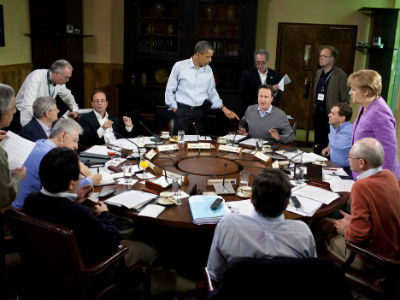
G-8 leaders during a
working session on global and economic issues on May 19, 2012 at Camp
David in the United States. Photo by: Pete Souza / White House
... plans for the G-8 Summit are taking shape. In
addition to tackling the threat of extremism and terrorist violence, and
addressing issues around agriculture, food and nutrition at a pre-G8
event, the key issues on the agenda are trade, tax and transparency –
government transparency and corporate transparency.
On tax and transparency, a number of issues seem to be competing for
attention on the G-8 agenda. These include transparency about the
revenues that companies pay to governments to extract oil and other
natural resources, transparency about land deals, transparency about tax
matters, transparency about who owns and controls shell companies,
transparency about budgets, and transparency about development
assistance.
Alongside these proposals are others to ensure that the
information unleashed by various transparency initiatives is
user-friendly and that civil society groups and others are able to make
use of that information to hold governments and companies to account.
Faced with a plethora of proposals and initiatives, there is a need
both for some prioritization and for a clear and compelling narrative
about how the various initiatives will work together to drive progress
against poverty and preventable disease. This is fundamentally a narrative about linking resources to results,
with transparency and information the main storyline. Here’s how the
story might go:
On resources, the G-8 countries commit to make faster progress on implementing the International Aid Transparency Initiative
to meet their aid transparency commitments. They support robust EU laws
on extractives transparency, help to develop a global standard on
extractives transparency and, where relevant, sign up to the Extractive Industries Transparency Initiative. And, they establish public registries of beneficial ownership.
On budgets and spending, the G-8 countries support BOOST,
a World Bank initiative to make information about budget revenues and
expenditures more accessible. They endorse and implement the principles
of the Global Initiative for Fiscal Transparency and support the Construction Sector Transparency Initiative so that there is transparency about how public resources are spent on infrastructure projects.
On results, the G-8 countries support another World Bank
initiative, called Service Delivery Indicators, which looks to improve
the information that is available about how health, education and other
services are delivered in developing countries. Straddling the resources
and budgets and spending categories, the G-8 also do more to support
better and more open contracting.