Lima, Peru, gets about half an inch of rainfall per year. Yet the atmospheric humidity is around 98 percent. UTEC, the country's major university of engineering and technology, took this peculiar problem and—with help from ad agency Mayo Draftfcb—devised a unique solution: a billboard that draws moisture out of that humid air and turns it into potable drinking water. Check out the case-study video below to see how it works. The billboard wasn't just a nice gesture, either. It served as a recruitment tool to get more students to apply to the university. Of course, it could be a prototype for village level systems.
Monday, February 24, 2014


Monday, January 6, 2014
US aid reform in 2014: 8 issues Congress may tackle for aid reform in 2014
Devex analysts Michael Igoe, Rolf Rosenkranz and Kelli Rogers prepared this overview to upcoming aid issues. An extract is below (the full article at this link).
Congress has long avoided comprehensive reform of U.S. development cooperation, and 2014 will likely be no different. But there’s a good chance lawmakers will consider a number of issues that could affect international development.
Things will get off to a fast and early start as Congress seeks to hammer out spending bills — including for U.S. foreign assistance — before Jan. 15.
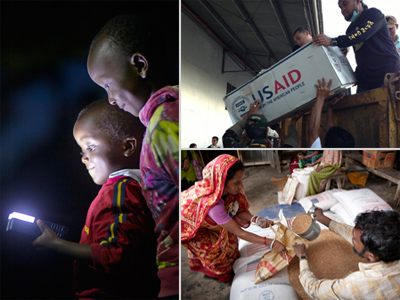
Here are eight issues to watch in 2014:
1. Food aid reform
Could 2014 be the year Congress decides to update decades-old U.S. food aid policy?
The U.S. system for delivering emergency and humanitarian food aid to countries in crisis is legally intertwined with the nation’s agriculture policy and legislated in five-year authorizations known as the farm bill.
That means U.S. agriculture and shipping interests have outsized influence over the way emergency food relief programs are delivered.
Farm bill conference committee negotiations have dragged on since November and a new bill could emerge early in 2014. Observers are optimistic that some measure of food aid reform, however modest, could be part of that package.
2. Electrify Africa
“Energy poverty” emerged as a high-profile issue for U.S. foreign aid in 2013, after President Barack Obama launched his Power Africa initiative during a visit to three African countries.
Electrify Africa would lend congressional support to the African energy poverty reduction effort, by granting the administration with clearance to coordinate action and resources across various deal-making agencies, and potentially by granting the Overseas Private Investment Corp. — the U.S. agency that offers debt financing for development projects — greater flexibility in terms of its investments.
3. Aid transparency and accountability
The Foreign Aid Transparency and Accountability Act failed by one vote in the last Congress. Aid experts are hoping 2014 is the year to finish the job on a piece of legislation that would make law an Obama administration vow to open data troves and require more transparent and systematic evaluation of foreign aid programs.
4. USAID organizational changes
A highly touted and high-level effort is under way to merge two USAID offices — the Office of Science and Technology and the Office of Innovation and Development Alliances — to make it easier for the agency and its partners to procure science and technology expertise and partner with social entrepreneurs.
If USAID is looking for some kind of minor congressional approval to complete its planned reorganization, the administration will likely ask Congress to make the change within a comprehensive omnibus bill to fund the entire U.S. government before Jan. 15.
5. International trade
Congress has a hard time passing trade agreements and related legislation, and that won’t change in 2014 — with some notable exceptions.
The trade promotion authority bill is expected to extend the strengthened focus on labor rights that the United States adopted in 2007, and lawmakers may even try to attach an update of the Generalized System of Preferences, the program under which the U.S. government unilaterally lowers tariffs on imports from developing countries. GSP expired in July.
Even if negotiations are successful, though, it could take a while for Congress to muster the energy to ratify the deal.
6. AGOA reauthorization
Sub-Saharan Africa’s exports of products covered by the African Growth and Opportunity Act have more than quadrupled since 2001, totaling $35 billion in 2012. But with AGOA set to expire in 2015, the debate among policymakers and within the development community about how to better the act is heating up, although legislation will not emerge until next year.
Reports show that many of the 39 countries currently eligible for AGOA aren’t making full use of the act’s preferences, so whether it needs to or will be expanded to cover more products, such as sugar and cotton, remains to be seen.
7. Emergency relief
USAID leaders have made it clear that future spending on foreign aid will increasingly be directed to fragile, conflict and disaster-prone states where many of the world’s extreme poor reside and struggle to find opportunities to climb out of poverty.
With crises emerging — or persisting — in Syria, the Central African Republic, South Sudan and elsewhere, the administration may call on Congress to authorize response measures as needed.
8. FAA overhaul
When he left Congress just over a year ago, then-Rep. Howard Berman, a California Democrat, released his latest proposal to overhaul the U.S. Foreign Assistance Act of 1961, the document which created the U.S. Agency for International Development and which has served as the blueprint for U.S. foreign assistance ever since.
Berman’s rewrite sought to “establish a framework for effective, transparent, and accountable United States foreign assistance.”
Most insiders think the chance of moving a new foreign assistance act through the current U.S. Congress is effectively zero.
Congress has long avoided comprehensive reform of U.S. development cooperation, and 2014 will likely be no different. But there’s a good chance lawmakers will consider a number of issues that could affect international development.
Things will get off to a fast and early start as Congress seeks to hammer out spending bills — including for U.S. foreign assistance — before Jan. 15.
Here are eight issues to watch in 2014:
1. Food aid reform
Could 2014 be the year Congress decides to update decades-old U.S. food aid policy?
The U.S. system for delivering emergency and humanitarian food aid to countries in crisis is legally intertwined with the nation’s agriculture policy and legislated in five-year authorizations known as the farm bill.
That means U.S. agriculture and shipping interests have outsized influence over the way emergency food relief programs are delivered.
Farm bill conference committee negotiations have dragged on since November and a new bill could emerge early in 2014. Observers are optimistic that some measure of food aid reform, however modest, could be part of that package.
2. Electrify Africa
“Energy poverty” emerged as a high-profile issue for U.S. foreign aid in 2013, after President Barack Obama launched his Power Africa initiative during a visit to three African countries.
Electrify Africa would lend congressional support to the African energy poverty reduction effort, by granting the administration with clearance to coordinate action and resources across various deal-making agencies, and potentially by granting the Overseas Private Investment Corp. — the U.S. agency that offers debt financing for development projects — greater flexibility in terms of its investments.
3. Aid transparency and accountability
The Foreign Aid Transparency and Accountability Act failed by one vote in the last Congress. Aid experts are hoping 2014 is the year to finish the job on a piece of legislation that would make law an Obama administration vow to open data troves and require more transparent and systematic evaluation of foreign aid programs.
4. USAID organizational changes
A highly touted and high-level effort is under way to merge two USAID offices — the Office of Science and Technology and the Office of Innovation and Development Alliances — to make it easier for the agency and its partners to procure science and technology expertise and partner with social entrepreneurs.
If USAID is looking for some kind of minor congressional approval to complete its planned reorganization, the administration will likely ask Congress to make the change within a comprehensive omnibus bill to fund the entire U.S. government before Jan. 15.
5. International trade
Congress has a hard time passing trade agreements and related legislation, and that won’t change in 2014 — with some notable exceptions.
The trade promotion authority bill is expected to extend the strengthened focus on labor rights that the United States adopted in 2007, and lawmakers may even try to attach an update of the Generalized System of Preferences, the program under which the U.S. government unilaterally lowers tariffs on imports from developing countries. GSP expired in July.
Even if negotiations are successful, though, it could take a while for Congress to muster the energy to ratify the deal.
6. AGOA reauthorization
Sub-Saharan Africa’s exports of products covered by the African Growth and Opportunity Act have more than quadrupled since 2001, totaling $35 billion in 2012. But with AGOA set to expire in 2015, the debate among policymakers and within the development community about how to better the act is heating up, although legislation will not emerge until next year.
Reports show that many of the 39 countries currently eligible for AGOA aren’t making full use of the act’s preferences, so whether it needs to or will be expanded to cover more products, such as sugar and cotton, remains to be seen.
7. Emergency relief
USAID leaders have made it clear that future spending on foreign aid will increasingly be directed to fragile, conflict and disaster-prone states where many of the world’s extreme poor reside and struggle to find opportunities to climb out of poverty.
With crises emerging — or persisting — in Syria, the Central African Republic, South Sudan and elsewhere, the administration may call on Congress to authorize response measures as needed.
8. FAA overhaul
When he left Congress just over a year ago, then-Rep. Howard Berman, a California Democrat, released his latest proposal to overhaul the U.S. Foreign Assistance Act of 1961, the document which created the U.S. Agency for International Development and which has served as the blueprint for U.S. foreign assistance ever since.
Berman’s rewrite sought to “establish a framework for effective, transparent, and accountable United States foreign assistance.”
Most insiders think the chance of moving a new foreign assistance act through the current U.S. Congress is effectively zero.
Wednesday, November 27, 2013
Immigration, World Poverty and Gumballs
Immigration - Global humanitarian reasons for current U.S. immigration are tested in this updated version of immigration author and journalist Roy Beck's colorful presentation of data from the World Bank and U.S. Census Bureau. The 1996 version of this immigration gumballs presentation, updated to 2010, has been one of the most viewed immigration policy presentations on the internet.
Presented by immigration author/journalist Roy Beck.
Presented by immigration author/journalist Roy Beck.
Wednesday, November 20, 2013
Rich Country Commitments to Foreign Aid
Which wealthy nations are helping poor ones the most? The Center for Global Development has just posted a ranking. Each year, the Commitment to Development Index ranks wealthy governments on how
well they are living up to their potential to help poor countries. The
Index scores seven policy areas that affect the well-being of others
around the world: aid, trade, finance, migration, environment, security,
and technology. Overall scores are the average of all the dimensions.
To explore the map to find out, click here for the interactive version.

To explore the map to find out, click here for the interactive version.

Thursday, November 7, 2013
The Battle for Hearts and Minds

Robert Kaplan, writing a commentary for Strategic Forecasting, argues for a harder more competitive approach to foreign aid. Certainly controversial, the full article can be obtained here. Extracts are below...
Geopolitics connotes hard power,
concerned as it is with the struggle over control of geographical
space, a struggle that is primarily military and economic.
Unsentimentality is the order of the day. Geopolitics and realism go
hand in hand, therefore. Humanitarian aid would seem to have no place in
this worldview. But that, as it turns out, is far too simplistic.
For
power is also the power to persuade, and persuasion can take the form of
winning friends, one village at a time. A policy that is purely
military and economic has no idealistic component, and in an age of
global media an idealistic component is required for credibility in the
public space. In fact, foreign aid, as it came to be known
during the Cold War, was a critical part of America's struggle against
world communism. Building schools and roads, and teaching children how
to read and farmers how to take advantage of the latest agricultural
methods, was not merely altruistic; for it had the ulterior motive of
demonstrating the superiority of America's values over those of its
adversaries. When in 1961 President John F. Kennedy launched the Peace
Corps, though his words were suffused with idealism, realpolitik was not
far from his thoughts.
But
the meaning of foreign aid has subtly shifted in the post-Cold War
years. According to a commonly received narrative prevalent in the
media, because communism has been vanquished, foreign policy is finally
able to pursue idealistic ends untainted by realpolitik. Henceforth,
foreign aid should be purely humanitarian, with minimal concern for
whether or not it benefits U.S. national interest.
Ironically, this very altruism that abjures national interest
has made America's foreign assistance programs not better but worse.
Foreign aid is like any other organized pursuit: It requires a
competitive mindset to excel. Aid workers must be aware of the
ideological, philosophical and political opposition they will likely
encounter in the field and prepare strategies to defeat it. They must
learn to compete, in other words...

... because the military thinks competitively and the foreign
assistance bureaucracy does not, the military is far more effective
than the State Department, with the result being the militarization of
foreign policy. Counter intuitively, the way to reduce America's reliance
on hard power is to get the foreign aid bureaucracy to adopt a harder,
more competitive approach to its own soft power. If the aid community
thought competitively, like the military and the intelligence
communities do, it would be more effective in the field, and the
militarization of foreign policy would consequently diminish. "The
imbalance between military and non-military instruments of power is
likely to continue unless civilian agencies develop approaches which
account for the contested landscapes in which they function," Schadlow
explains. She quotes an Australian government aid expert: "Aid is 10
percent technical and 90 percent political."
Aid,
in other words, is a form of political warfare, something that
America's Cold War presidents well understood. That doesn't mean, for
example, that you export democracy-building programs to every
non-democratic country as part of a moralistic foreign policy that pays
no heed to realpolitik. For there may be a few places where you will
want to cultivate authoritarian leaders, and such programs would then
undermine your strategic goals. Aid is not some politically neutral tool
that operates separately from foreign policy -- rather, aid, as well as
seeking to do good, must also advance a state's interests. And the more
tough and competitive the aid mindset, the more likely it is to
succeed.
We
must stop putting humanitarian aid on a pedestal. While the geopolitical
interests and moral values of a great power like the United States do
not always overlap, most of the time they do, and therefore there is
nothing debased or cynical about seeing civil and military power as two
inextricable aspects of the same foreign policy machine. Indeed,
efficient humanitarian aid requires language and other forms of cultural
area expertise, which is also of use to the military. The military,
meanwhile, uses operational and strategic planning processes to
determine who the opponents are likely to be once soldiers and Marines
hit the ground. The aid bureaucracy should do likewise. Each branch of
foreign policy can assist and leverage -- and learn from -- the other...
... Face it: the militarization of foreign policy was not only
the result of decisions taken by the younger Bush administration, or
even of a State Department starved of funds. It was also the result of
the thoroughly undynamic mindset of Foggy Bottom. Rather than have the
military become softer, the State Department has to become harder. That's the real road to soft power.Obtain full article from Stratfor here.
Monday, November 4, 2013
Pennies from heaven
Giving money directly to poor people works surprisingly well. But it cannot deal with the deeper causes of poverty. Article from The Economist (link here).

The 25-year-old carpenter knew nothing of this until he came home one day to find that strangers had given his wife a mobile phone linked to a bank account. Next came a $1,000 windfall, which they were free to spend on whatever they liked.
The idea sounds as extraordinary as throwing money out of helicopters. But this programme, and others like it, are part of a shift in thinking about how best to use aid to help the poorest. For decades, it was thought that the poor needed almost everything done for them and that experts knew best what this was. Few people would trust anyone to spend $1,000 responsibly. Instead, governments, charities and development banks built schools and hospitals, roads and ports, irrigation pipes and electric cables. And they set up big bureaucracies to run it all.

Read the full article here.
Wednesday, July 31, 2013
Impact Evaluation on the Rise
“Impact Evaluations: Can we learn more? Better?" conference was just co-hosted by the Center for Global Development and the International Initiative for Impact Evaluation (3ie). The conference was an opportunity to take stock of the current
production of studies that aim to attribute changes in outcomes to
particular interventions. In 2006, the Center published a working group report
which argued that too few good quality impact evaluations were being
conducted, what it called an “evaluation gap.”
In response to that
report, 3ie was created in 2009.
Now, four years later, the time is ripe to look at what has
happened and consider what else might be done to make sure good evidence
is available and used in improving public policy. There is a great deal more good research being done. The number of
impact evaluations being published has more than tripled between 2007
and 2011. The total, about 120 in 2011, is still far less than is
probably needed if you consider that there are more than 100 countries
working in more than a dozen sectors with numerous interventions worth
assessing.

Details on the quality of the increase of evaluation are detailed in this CGD article.
Subscribe to:
Comments (Atom)