Monday, November 28, 2011

Emerging Donors Changing Foreign Assistance

In a new Center for Global Development white paper, a look is taken at the scale and scope of emerging donors, many of which are developing economies themselves. On the basis of a survey of the literature, CGD find that estimates of annual aid flows from new donors (so-called non-DAC donors) vary greatly and are somewhere between $11 billion and $41.7 billion, or 8 and 31 percent of global gross Official Development Assistance (ODA). 

It is found that new donors are not a monolithic group but instead represent three distinct models of aid delivery, which are described as the OECD Development Assistance Committee (DAC) Model, the Arab Model and the Southern Model. 

While there is seen the need to increase transparency and accountability of aid flows across these delivery models, the authors Julie Walz and Vijaya Ramachandran do not see a convergence to the DAC model. Rather, emerging donors may follow different paths, in accordance with their own traditions and standards. 


They argue that encouraging aid transparency, especially reporting data on project-level assistance, must be the core focus of the aid community. To engage the non-DAC donors, the forum for international aid coordination might need to be moved away from the OECD-DAC platform; DAC could instead serve as one donor caucus within a larger international system of aid reporting.


Their candidates for this independent body include the U.N. Development Cooperation Forum and the International Aid Transparency Initiative.

Read the 30 page paper here.

Saturday, November 19, 2011

Innovative Approaches to Aid Effectiveness

An article in the latest issue of Fortune magazine focuses on MCC and its innovative approach to development, stating, "Early results suggest the model is working," and "the agency certainly gives the taxpayer real bang for the buck."


Meanwhile, the world’s top development officials meet next week in Busan, South Korea, for the 4th High-Level Forum on Aid Effectiveness.

While in Busan, the U.S. Government delegation, led by Secretary of State Hillary Rodham Clinton, will be working with other donors and recipient countries to redefine how everyone thinks about results. A goal will be to shift the focus from measuring results by dollars spent to demonstrable outcomes and actual impact, an approach that agencies such as MCC has continued to develop and implement since its creation nearly eight years ago. 

MCC has published a variety of white papers and facts sheets on Aid effectiveness. Visit the link here to access the resources.

Friday, November 4, 2011

Challenges for the Millennium Challenge Corp

Lorenzo Piccolo writing in a Devex article provides a short history and an overview to the upcoming opportunities and challenges for the Millennium Challenge Corporation. A few extracts are below. It is a very good summary well-sourced.
Read the full article here. 

The MCC was founded on the premise that policies do matter in development. Since the 1980s, portions of U.S. development assistance have been allocated on the basis of policy performance. President Bush’s initiative broke new ground because all MCC grants, known as compacts, would only be within reach of a select group of poor countries that had taken some command of its own policies that would induce its own development. 

Here’s how the MCC works: to qualify for large, five-year, untied grants for poverty reduction and economic growth, poor countries must perform better than their peers on 17 indicators that measure good governance, economic openness, and social sector investment. 

Once a country qualifies and is selected by the MCC, it must identify its funding priorities and develop a program proposal in consultation with civil society. Before implementation, a compact is signed between the MCC and the recipient country that records mutually agreed objectives and benchmarks. The MCC provides guidance and oversight throughout the process. Since its establishment in 2004, the MCC has signed compacts with 23 countries totaling $8.2 billion, well below President Bush’s $5 billion annual commitment. 

Yet while funding for the MCC has fallen far short of expectations, there is broad agreement in the development community that the agency has nonetheless been a worthwhile experiment and effective aid delivery model. From the Philippines to Lesotho, in what has been called the “MCC effect,” an assortment of countries have enacted meaningful reform in order to join the ranks of compact countries. 

And beyond creating incentives for policies widely believed to support development, the MCC is also producing results on the ground. According to MCC CEO Daniel W. Yohannes, in testimony before Congress, MCC programs have trained over 150,000 farmers and supported construction of more than 890 kilometers of road.

Read the full article here.

Wednesday, November 2, 2011

NGOs Criticize World Bank Lending Plan

In a recent Guardian article by John Vidal, NGOs say the new World Bank Programme-for-Results Lending would allow countries to sidestep tough social and environmental safeguards that recipients of World Bank loans must normally meet.

An extract: 
It's couched in 60 pages of near-incomprehensible economic-speak, but a radical World Bank plan (link here) to set up a new way to lend money to developing countries is being called a potential disaster for indigenous peoples, the environment and human rights. The proposal, called A New Instrument to Advance Development Effectiveness: Programme-for-Results Lending (P4R), would lend money according to results achieved by projects.

Photograph: Jorge Silva/Reuters

The proposal was published in February, and phase II consultations ended recently. Board approval is expected by the end of the year. Some of the NGOs that keep an eye on the bank's activities – International Rivers, Friends of the Earth US and Bank Information Centre – say the clear intention is to allow countries to sidestep dozens of tough, and expensive, social and environmental safeguards which recipients of World Bank loans must normally meet. Read full piece here.

Monday, October 31, 2011

Focus on African Infrastructure

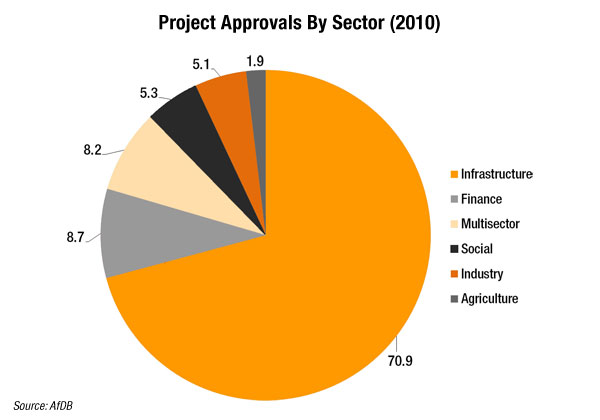
In a recent analysis for Devex, Louie-An Pilapil provided a concise overview of the African Development Bank's funding priorities. Since 2010, the African Development Bank became the leading source of multilateral funding for new African infrastructure, beating out the World Bank for the first time. See article here.

The majority of the Bank’s approved projects for 2010 were focused in the infrastructure sector, specifically transportation and power, totaling $3.9 billion (see chart).


While AfDB’s internal 2011 Annual Development Effectiveness Review stresses sector diversification in areas such as private sector development, regional integration, higher education, and science and technology, there is little doubt that infrastructure will remain the Bank’s core sector for years to come. In this sense, the AfDB is following the path of the Asian Development Bank which was primarily an infrastructure-focused institution in its early years, but has persistently ventured into other key development areas.


AfDB’s infrastructure concentration has played out nicely for the Chinese who have already proven masterful dealing with African countries on a bilateral basis by negotiating through innovative project financing and implementation packages. It now appears that AfDB is harnessing China’s commitment to Africa and using it as a tool to promote regional integration. Indeed, China has been able to penetrate the AfDB and secure an astounding number of high-value contracts largely on the basis of cost. 

The United States ranked 16th in terms of total AfDB funds awarded in 2010 highlighting the fact that U.S. construction and infrastructure firms remain somewhat on the AfDB sidelines and have not yet committed themselves to working with the Bank. Despite comparatively little activity from American firms, AfDB is scheduled to open a Washington D.C. office in 2012 in an effort to facilitate and accelerate American engagement with the Bank.   Read full article here.

The Millennium Development Goals 2011 Report for Africa is linked here.  An extract of the conclusions (p 124) is below:


Overall, the pace of Africa’s progress toward the
MDGs has been slow and generally insufficient to
meet the target date. Performance has also been
mixed and characterized by substantial variations
in access to basic social services across subregions
and countries, as well as within countries. Intracountry
variations in performance are typified by
rural–urban splits and disparities across income
groups. Where spatial differences in access to basic
social services coincide with ethnic boundaries,
horizontal inequalities (i.e., inequalities across different
ethnic groups) are exacerbated. This could
heighten tensions and become a source of social
unrest.


Sunday, October 30, 2011

High Impact Development: Effects of Austerity

In another excellent analysis, Connie Veillette of the Center for Global Development lays out some thoughts on providing more focus and selectivity for USAID efforts. 

She focuses on 3 indicators:

1) a reduction in the number of countries receiving aid, a reduction in aid as countries move into higher income categories, or a recognition that some countries are not in a position to benefit from assistance;

2) resources focused in a smaller number of sectors identified as crucial for economic growth; and

3) selectivity around high-impact initiatives.

After some analysis of the current situation, she provides 4 recommendations for moving forward in today's environment of austerity and lower funding:

  • Re-evaluate and eliminate small programs. 
  •  Create a State Department aid account for strategic/political purposes.  
  • Focus on a smaller number of objectives that have big impacts and get out of unrelated programs. 
  • Identify comparative advantage. 
Read the full elaboration here.


Friday, October 28, 2011

USAID Agenda for Private Sector Engagement


USAID Administrator Rajiv Shah presented at the USAID Public-Private Partnership Forum held Oct. 20 in Washington. D.C. , where he outlined a new direction for the agency’s work and encouraged the development community to “embrace a new wave of creative, enlightened capitalism” that connects profit, wealth and development. Full remarks are linked here.

In the coming years, the U.S. Agency for International Development is expected to pursue more partnerships with local and foreign private corporations and to boost investments in business-related reforms in partner countries as the agency moves to make private sector development a key part of its mission.

As noted in a recent Devex article by Ivy Mungcal, "This push to elevate partnerships and support for private sector-led development as a key part of USAID’s mission is in line with U.S. President Barack Obama’s development policy, which includes promoting broad-based economic growth as one of its pillars. It is also in line with an emerging trend among donors to engage in development efforts that would help recipient countries graduate eventually from aid dependence.

USAID, according to Shah, would tap partnerships with foreign and local private corporations, including multinationals such as Coca-Cola and Pepsi Co., to leverage U.S. investments in the developing world. “I’m not talking about partnership for partnerships sake,” Shah stressed. “I’m talking about helping support the work of markets that can deliver profits and create opportunities for women, minorities and the poor. We must partner with the private sector much more deeply from the start, instead of treating companies as just another funding source for our development work.”

USAID aims to create and maintain these partnerships through its recently launched Office of Innovation and Development Alliances supervised by Maura O’Neill, USAID’s senior counselor and chief innovation officer (recent remarks here).